
Benefits of Block Play: 7 Ways Building Blocks Help Kids Learn
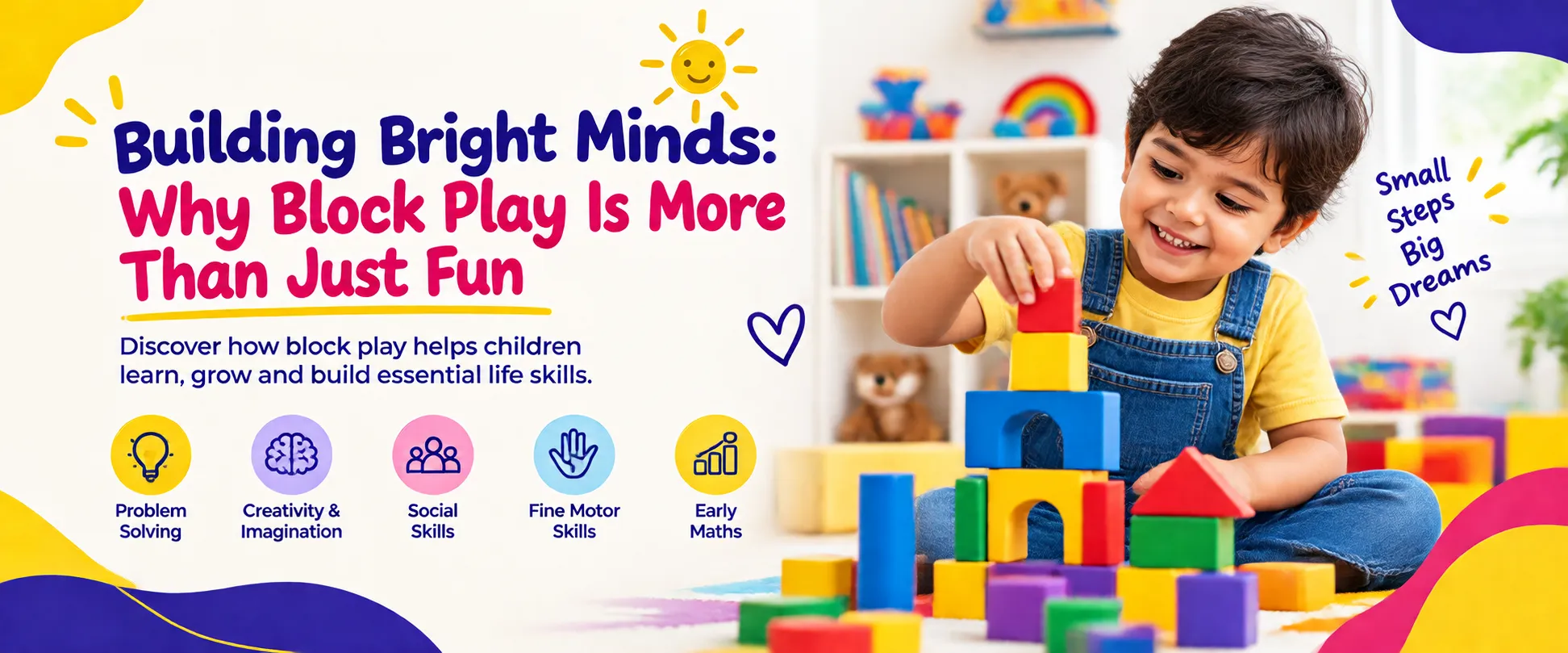
Discover the benefits of block play for children, from problem-solving and spatial skills to early maths, creativity, fine motor skills and teamwork.




Block play is an important early childhood activity because it supports problem-solving, spatial awareness, fine motor skills, early maths, creativity, communication and persistence. When children stack, balance, connect and rearrange blocks, they experiment with ideas, solve problems and learn through hands-on play.
The benefits of block play go far beyond building towers. Open-ended construction play gives children opportunities to make choices, test ideas, collaborate with others and learn from what happens when a structure succeeds—or falls down.
A tower reaches higher and higher until crash! it tumbles to the floor. Instead of giving up, a child smiles, gathers the blocks, and begins again.
To adults, block play may seem like simple entertainment. To children, it's a world of discovery, creativity, and problem-solving. Every tower, bridge, or castle they build strengthens important developmental skills that support learning both in and out of the classroom.
Whether using wooden blocks, magnetic tiles, foam bricks, or construction toys, block play is one of the most valuable activities in early childhood.
Block play is one example of how children can develop skills through hands-on, play-based experiences. Explore Kidzee's preschool programmes to learn more about early childhood learning.
Why Is Block Play Important for Child Development?
Blocks are considered open-ended toys, meaning there is no right or wrong way to play with them. Children decide what to build, how to build it, and what to do when things don't go as planned.
This freedom encourages exploration, creativity, and independent thinking while developing a wide range of essential skills.
Benefits of Building Blocks
Building blocks are valuable because they combine physical, cognitive, creative and social learning in one open-ended activity. Children can experiment with balance, shape, size and position while also developing hand control, communication, planning and problem-solving.
Because there is no single finished product, children can make decisions, change their ideas and try again. This makes block play a particularly flexible form of play-based learning for young children.
- Develops Problem-Solving Skills
Every construction project presents a challenge.
Questions naturally arise:
- Which block should go at the bottom?
- Why did my tower fall?
- How can I make it taller?
- What will help my bridge stay strong?
As children experiment, they learn to test ideas, make changes, and find solutions independently.
- Builds Spatial Awareness
One of the greatest benefits of block play is the development of spatial skills.
Children learn concepts such as:
- Above and below
- Next to and behind
- Near and far
- Balance and symmetry
- Size and position
These early spatial skills support future learning in mathematics, science, engineering, and design.
Spatial awareness developed through block play can help children understand how objects relate to one another in space. These early experiences can provide a foundation for later learning involving geometry, measurement, design and construction.
- Encourages Early Math Learning
Building blocks naturally introduce mathematical concepts.
Children explore:
- Counting blocks
- Sorting by colour or size
- Comparing lengths and heights
- Recognising shapes
- Creating patterns
- Understanding balance and measurement
Learning happens naturally through play rather than formal instruction.
Block play is a natural way to introduce early maths concepts because children can see and manipulate quantities, shapes and measurements.For example, they might count how many blocks they need, compare which tower is taller, sort blocks by colour or size, or create repeating patterns.
Hands-on activities such as building, sorting, counting and pattern-making can complement the broader play-based learning approach at Kidzee.
How Does Block Play Support STEM Learning?
Block play can introduce young children to early STEM ideas through hands-on exploration of balance, structure, shape, measurement, cause and effect and problem-solving.A child building a bridge, for example, may naturally experiment with which blocks provide support and what happens when the structure becomes too heavy.
These experiences encourage children to ask questions, test ideas, observe results and make changes—important habits for future science, technology, engineering and maths learning.
- Strengthens Fine Motor Skills
Picking up, stacking, balancing, and connecting blocks strengthens the small muscles in children's hands and fingers.
These skills later support writing, drawing, cutting with scissors, and other everyday tasks.
Block play also involves hand-eye coordination, grasping, positioning and controlled movements, giving young children repeated opportunities to strengthen fine motor control through meaningful play.
- How Does Block Play Develop Social Skills?
When children build together, block play creates opportunities to practise sharing, turn-taking, cooperation, negotiation and communication. Children may need to decide what to build, divide materials, listen to another child's idea or solve a disagreement about how a structure should be created.
These everyday interactions can help children develop social confidence and learn how to work towards a shared goal.
- Inspires Creativity and Imagination
Today, the blocks become a castle.
Tomorrow, they're a zoo, a rocket, or a bustling city.
Because there are no fixed rules, children use their imagination to create unique structures and invent stories around them. This kind of imaginative play encourages flexible thinking and creativity.
- Builds Language and Communication Skills
Block play becomes even richer when children play together.
They discuss ideas, explain plans, negotiate roles, and solve problems as a team.
You might hear conversations like:
- "Let's build a bridge."
- "Can you pass me the long block?"
- "Our tower needs another block."
These interactions strengthen vocabulary, listening, and communication skills.
- Encourages Persistence and Resilience
Not every structure stays standing and that's okay.
When towers collapse or bridges fail, children learn that mistakes are part of learning. They adapt, try new ideas, and build again.
This process teaches patience, perseverance, and confidence in solving challenges.
- How Does Block Play Support Cognitive Development?
Block play supports cognitive development by encouraging children to plan, remember ideas, compare possibilities, solve problems and adjust their approach. When a structure does not work, children can observe what happened, make a change and test their new idea.
This kind of hands-on learning encourages flexible thinking and gives children opportunities to learn through experimentation rather than simply being told the answer.
Block Play Ideas for Toddlers and Preschoolers
The way children use blocks changes as their motor, language, cognitive and social skills develop.
Toddlers
Toddlers may begin by carrying, exploring, stacking and knocking down blocks.Large, lightweight blocks can provide opportunities to practise grasping, balancing and simple cause-and-effect learning.
Young Preschoolers
Preschoolers can begin combining blocks, creating simple structures, sorting materials and talking about what they are building.Adults can introduce simple challenges without taking control of the child's construction.
Older Preschoolers
Older preschoolers may create more detailed structures, plan what they want to build, use patterns and shapes, and collaborate with other children.They can also experiment with challenges involving height, balance, bridges and limited numbers of blocks.
The goal is not to produce a perfect structure. Open-ended exploration is part of the learning.
Simple Ways to Extend Block Play
Parents and teachers can enrich building experiences with a few simple ideas:
- Add Everyday Materials
Combine blocks with:
- Toy animals
- Small cars
- Fabric pieces
- Cardboard tubes
- Wooden people
- Natural materials like leaves or pebbles
These additions inspire imaginative storytelling and creative thinking.
- Introduce Building Challenges
Invite children to:
- Build the tallest tower.
- Create a bridge that holds toy cars.
- Design a house with four rooms.
- Build something using only ten blocks.
- Make a pattern with different coloured blocks.
Challenges encourage planning and problem-solving while keeping play enjoyable.
- Talk About Their Creations
Ask open-ended questions like:
- Tell me about what you built.
- How did you make it so tall?
- What happened when it fell?
- What would you like to build next?
These conversations help children reflect on their thinking and develop language skills.
Choosing the Right Blocks
Construction toys come in many forms, including:
- Wooden building blocks
- Magnetic tiles
- Foam blocks
- Interlocking bricks
- Large cardboard blocks
Choose age-appropriate materials that are safe, durable, and encourage open-ended exploration rather than following fixed instructions.
Block play supports almost every area of early childhood development cognitive, physical, social, emotional, and creative.
As children build, they are learning to think critically, communicate, collaborate, and persevere. They are developing skills that will support them in mathematics, science, literacy, and everyday problem-solving.
The next time you see a child carefully balancing blocks into a tower or proudly showing off a handmade castle, remember that something much bigger is happening.
They are exploring, experimenting, imagining, and learning.
Because block play isn't just about building structures—it's about building confident, capable, and curious young minds, one block at a time.
For more ideas on supporting children's development through age-appropriate play and learning, explore Kidzee's preschool programme.
How Parents Can Support Block Play at Home
You do not need a complicated setup to encourage block play at home.A small collection of age-appropriate blocks and a safe space to build can provide plenty of opportunities for exploration.
Parents can:
- Leave blocks accessible so children can choose when to build.
- Allow children to lead the activity.
- Ask open-ended questions rather than giving solutions.
- Join the play when invited.
- Add toy animals, cars or household materials to extend pretend play.
- Celebrate experimentation rather than focusing on whether a structure stands.
- Give children time to solve simple building problems independently.
The most valuable role for adults is often to observe, encourage and ask questions without taking over the construction.
Benefits of Block Play: Key Takeaways
Block play is more than a fun construction activity—it is a hands-on way for children to explore how things work while developing a wide range of skills.
- Builds problem-solving and flexible thinking
- Develops spatial awareness
- Introduces early maths concepts
- Strengthens fine motor skills and hand-eye coordination
- Encourages creativity and imagination
- Supports language and communication
- Develops cooperation and social skills
- Encourages persistence and resilience
- Provides early opportunities for STEM exploration
- Supports learning through open-ended play
For more resources on play-based early childhood learning, explore Kidzee.