
Flashcards for Kids: 7 Smart Ways to Make Learning Fun
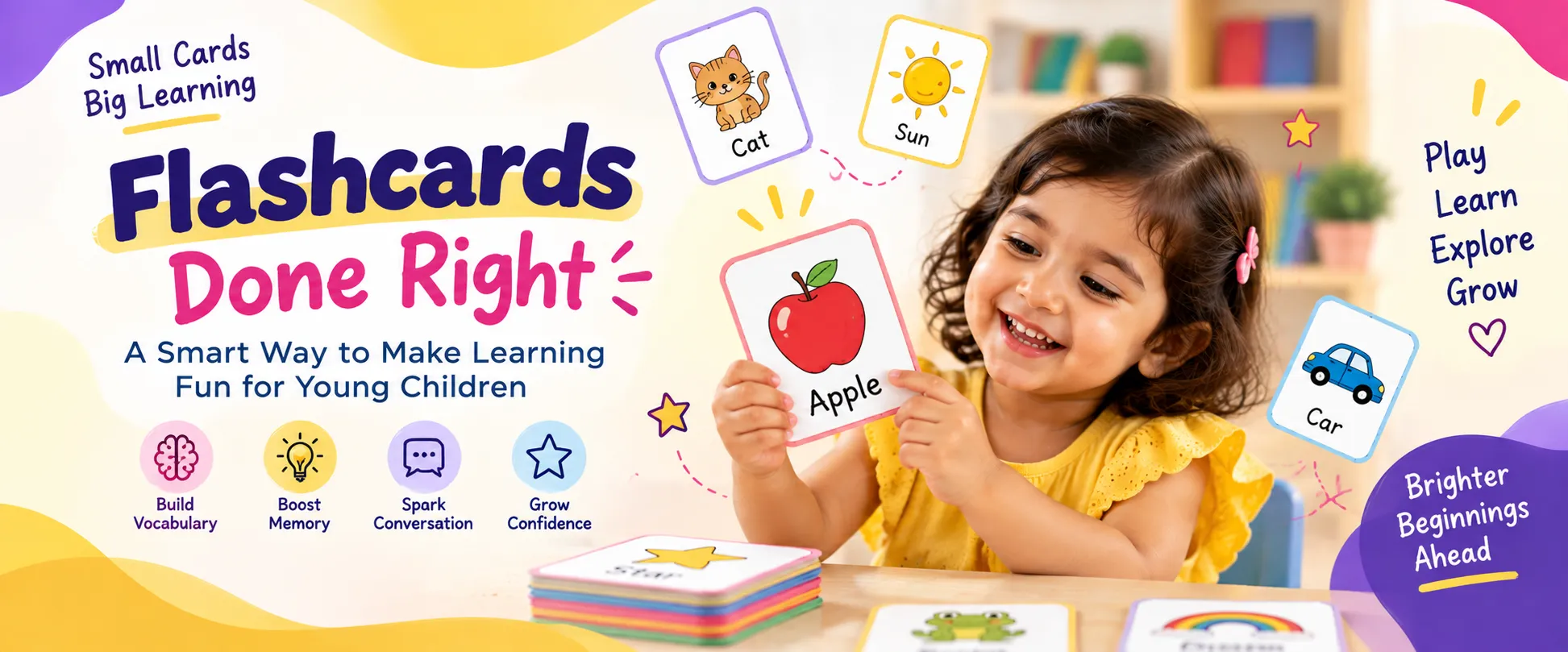
Discover how to use flashcards for toddlers and preschoolers to build vocabulary, memory, recognition and early learning skills through play.




Flashcards for kids can be a simple and engaging learning tool for building vocabulary, recognising letters, numbers, colours and shapes, strengthening memory and encouraging conversation. When used alongside play and hands-on experiences, educational flashcards can support early learning without turning it into a formal lesson.
Flashcards have long been a favourite learning tool for parents and teachers. From colourful alphabets and numbers to animals, shapes, and everyday objects, they make learning visual, engaging, and interactive.
But are flashcards really useful? The answer is yes when used the right way.
For toddlers and preschoolers, flashcards work best as a playful learning aid rather than a memorisation exercise.
Flashcards are not meant to replace play, storytelling, or hands-on experiences. Instead, they are most effective when used as a fun learning aid that sparks curiosity, conversation, and exploration.
Why Flashcards Work
Young children learn best through repetition, visual cues, and meaningful interactions. Flashcards combine all three, helping children recognise, remember, and recall information more easily.
Educational flashcards can be particularly useful for introducing and reinforcing familiar concepts through repeated, visual exposure.
When used appropriately, educational flashcards can help children:
- Build vocabulary
- Recognise letters, numbers, colours, and shapes
- Strengthen memory and recall
- Improve attention and concentration
- Develop language and communication skills
- Increase confidence through repeated success
Flashcards can also encourage children to name, describe, compare and connect what they see with objects and experiences in the real world.
The key is to keep learning playful rather than making it feel like a test.
Are Flashcards Useful for Young Children?
Absolutely but only when they are used to encourage interaction.
Instead of asking children to memorise answers, use flashcards to start conversations.
For example, if you show a picture of an apple, ask:
- What colour is it?
- Have you eaten an apple before?
- Is it sweet or sour?
- Can you think of another fruit?
These simple conversations help children connect new words with real-life experiences, making learning more meaningful.
This approach turns flashcards into a starting point for language development, observation, recall and critical thinking rather than a simple question-and-answer exercise.
How to Use Flashcards Effectively
-
Keep Sessions Short
- Young children have short attention spans. Five to ten minutes of focused learning is far more effective than a long session.
- Stop while your child is still interested so they look forward to the next activity.
The exact duration should depend on your child's age, interest and attention. The goal is an enjoyable learning experience, not completing a set number of cards.
-
Focus on One Concept at a Time
- Avoid introducing too many flashcards at once.
- Choose one category such as:
- Animals
- Fruits
- Vehicles
- Alphabet letters
- Numbers
- Colours
- Shapes
- Once children are comfortable, gradually introduce new concepts.
Keeping a small set of related cards together can make it easier for children to recognise similarities, learn new vocabulary and make connections between concepts.
-
Turn Learning into a Game
- Flashcards become much more exciting when combined with play.
- Try activities like:
- Memory matching games
- Treasure hunts
- "Find the object" around the house
- Sorting by colour or category
- Guess the card using clues
- Acting out the picture on the card
- Children learn best when they are actively involved.
Play-based flashcard activities can encourage movement, problem-solving, recall and social interaction while keeping children engaged.
-
Encourage Conversation
- Flashcards should promote communication, not just recognition.
- Instead of asking, "What is this?" every time, ask open-ended questions:
- Where have you seen this?
- What sound does it make?
- What does it do?
- Can you tell me a story about it?
- This develops vocabulary, critical thinking, and confidence.
For preschoolers, talking about the image can be just as valuable as identifying it. Encourage children to describe what they see, make connections and share their own experiences.
-
Repeat Often
- Repetition is one of the most effective ways young children learn.
- Review familiar flashcards regularly while introducing one or two new ones each week. Seeing the same images multiple times strengthens memory without overwhelming children.
Revisiting familiar concepts also gives children opportunities to recall information and experience success, while new cards gradually expand their learning.
What Kind of Flashcards Should You Use?
Choose flashcards that are:
- Bright and colourful
- Age-appropriate
- Simple and uncluttered
- Durable enough for little hands
- Based on real-life objects whenever possible
For toddlers and preschoolers, realistic pictures often help children make stronger connections with the world around them.
When choosing flashcards for toddlers, look for clear images, simple categories, age-appropriate vocabulary and minimal visual clutter.
Common Mistakes to Avoid
Flashcards are most effective when they are enjoyable. Avoid these common mistakes:
- Using too many cards at once
- Turning learning into memorisation drills
- Correcting every mistake immediately
- Expecting children to learn quickly
- Comparing one child's progress with another
Every child learns at their own pace, and learning should always feel encouraging.
Avoid using flashcards as a test of how quickly a child can recognise or recall information. The aim is to encourage curiosity, communication and confidence.
Pair Flashcards with Real-Life Experiences
Flashcards become much more meaningful when children can connect them to everyday life.
- If today's flashcard is a banana, let your child hold one during snack time.
- If you're learning about birds, watch them in the garden or park.
- If the flashcard shows a circle, ask your child to find circular objects around the house.
These real-world connections help children understand concepts rather than simply memorising pictures.
This connection between visual learning and real-world experiences can make new concepts more meaningful and easier for children to explore.
Flashcards Are Just One Part of Learning
While learning flashcards are a wonderful educational tool, they work best alongside storytelling, songs, pretend play, outdoor exploration, art, and hands-on activities.
Young children learn through experiences, conversations, movement, and play. Flashcards simply add another engaging way to reinforce those experiences.
A balanced early learning approach combines flashcards with play-based learning, creative activities, physical play, stories and real-world exploration.
The purpose of flashcards isn't to create little experts overnight. It's to nurture curiosity, build confidence, and make learning enjoyable.
When children laugh, talk, explore, and play while using flashcards, they aren't just remembering pictures they're developing language, strengthening memory, and building a lifelong love of learning.
Sometimes, the simplest tools create the biggest learning moments.
For more ideas on supporting your child's development through playful, age-appropriate learning experiences, explore Kidzee's preschool programmes.