
Growth Mindset in Children: 7 Ways Parents Can Build It
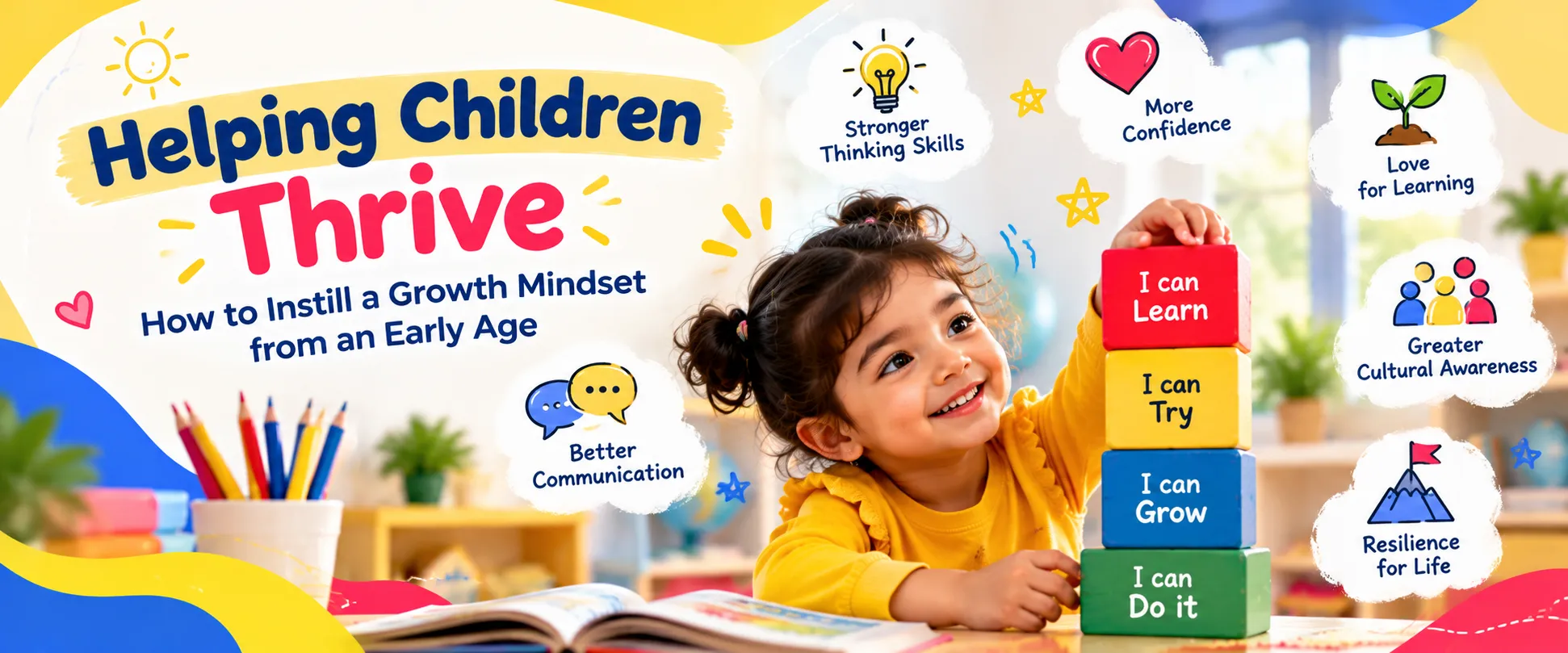
Learn how to develop a growth mindset in children with practical tips for parents, including positive self-talk, effort, resilience, problem-solving and learning from mistakes.




A growth mindset in children is the belief that abilities and skills can develop through effort, practice, effective strategies and learning from mistakes. Parents can encourage a growth mindset by praising effort and progress, helping children reframe mistakes, encouraging problem-solving, modelling persistence and using language such as “you can't do it yet” rather than “you can't do it.”
"I can't do it."
It's a phrase many parents and teachers hear when children face a difficult puzzle, struggle to write their name, or find it hard to ride a bicycle. While it's natural for children to feel frustrated, what they believe about their abilities can shape how they respond to challenges.
This is where a growth mindset plays an important role.
A growth mindset teaches children that abilities are not fixed—they can improve through effort, practice, and learning from mistakes. Instead of giving up when something feels difficult, children learn to see challenges as opportunities to grow.
Developing a growth mindset in early childhood does not mean telling children that they can achieve anything simply by trying harder. Instead, it means helping them understand that learning takes time, challenges are part of the process, mistakes provide useful information and asking for help is a positive part of learning.
These everyday experiences can help children develop persistence, confidence, curiosity and a willingness to try again when something feels difficult.
A growth mindset is one part of early childhood development, alongside social, emotional, cognitive and physical development.
What Is a Growth Mindset in Children?
A growth mindset is the belief that intelligence, talents, and abilities develop over time with effort, persistence, and learning.
Children with a growth mindset understand that:
- Making mistakes is part of learning.
- Practice helps them improve.
- Challenges help them grow.
- Asking for help is a strength, not a weakness.
A growth mindset does not mean that every child will find every task easy or that effort alone guarantees success. It means children can learn to believe that their abilities can develop and that they can use practice, strategies, feedback and support to improve.
Rather than saying, "I'm not good at this," they begin to think, "I'm still learning."
This simple shift in thinking builds resilience and confidence that lasts a lifetime.
Why Is a Growth Mindset Important for Children?
Early childhood is the perfect time to develop positive attitudes towards learning. During these years, children are naturally curious and eager to explore.
When adults encourage a growth mindset, children become more willing to:
- Try new activities.
- Solve problems independently.
- Persist when tasks become difficult.
- Learn from mistakes.
- Build confidence in their abilities.
- Develop a love for learning.
These qualities support success not only in school but also in everyday life.
A growth mindset can influence how children approach challenges, mistakes and unfamiliar experiences. Instead of seeing difficulty as proof that they are “not good” at something, children can learn to view challenges as part of the learning process.
For young children, this mindset can be encouraged through everyday experiences such as puzzles, building, drawing, learning new physical skills, trying new games and solving problems independently.
Growth Mindset vs Fixed Mindset in Children
A fixed mindset is the belief that abilities are largely fixed, while a growth mindset focuses on the idea that skills can develop through learning, practice, strategies and support.
| Fixed Mindset | Growth Mindset |
|---|---|
| “I'm not good at this.” | “I'm still learning this.” |
| “I can't do it.” | "I can't do it yet." |
| “I made a mistake, so I'm bad at it.” | "I can learn from my mistakes. |
| “This is too difficult.” | "I can try another way." |
| “I need to be perfect.” | "I can improve with practice |
The goal is not to eliminate frustration. Children can still feel disappointed or frustrated while learning to respond to those feelings constructively.
How Parents Can Encourage a Growth Mindset in Children
- Praise effort, not just results. Focus on hard work, persistence, and progress.
- Teach that mistakes are opportunities to learn. Help children see setbacks as part of the learning process.
- Use positive language. Encourage phrases like, "I'll keep trying" or "I'm still learning."
- Encourage problem-solving. Ask questions that help children think of their own solutions.
- Be a role model. Let your child see you learning from your own mistakes and trying new things.
The most effective growth mindset messages are specific and realistic. Instead of giving general praise such as “You're so smart,” parents can recognise the process: “You kept trying different ways,” “You practised that several times,” or “You found a new way to solve the problem.”
Use “Yet” to Encourage a Growth Mindset
One simple way to encourage growth mindset language is to add the word “yet”. When a child says, “I can't do this,” a parent can respond, “You can't do this yet.” This small change can help shift the focus from a permanent limitation to a skill that is still developing.
Other useful phrases include:
- “Let's try another way.”
- “What could you do differently?”
- “What did you learn from that?”
- “Which part was difficult?”
- “Would you like some help?”
- “You are making progress.”
Growth Mindset Activities for children: Create Opportunities to Try New Things
Parents can turn everyday play into growth mindset activities for kids by choosing experiences that involve manageable challenges. Puzzles, blocks, drawing, crafts, music, simple cooking tasks, physical activities and age-appropriate problem-solving games can all give children opportunities to practise persistence and learn from mistakes.
Encourage children to explore activities that challenge them, such as:
- Building with blocks
- Completing puzzles
- Painting and drawing
- Learning a new song
- Riding a bicycle
- Helping with simple cooking tasks
These experiences teach children that improvement comes through practice and persistence.
Many of these experiences can be introduced naturally through learning through play, where children can explore, experiment and solve problems.
Encourage Positive Self-Talk
Help children replace negative thoughts with encouraging ones.
Instead of:
- "I can't do this."
Encourage them to say:
- "I'll keep trying."
- "I'm getting better."
- "This is difficult, but I can learn."
Positive self-talk builds confidence and resilience over time.
How to Praise Children Without Creating a Fixed Mindset
Praise can be more useful when it recognises a child's process rather than labelling the child as naturally talented. Instead of focusing only on results, parents can notice effort, strategy, persistence, improvement, creativity and willingness to try.
For example:
Instead of “You're very clever,” say “You worked hard to figure that out.”
Instead of “You're a natural artist,” say “I noticed how you experimented with different colours.”
Instead of “You're the best,” say “You kept practising until you improved.”
This does not mean children should never receive praise. The aim is to make praise specific enough to help children understand what contributed to their progress.
How Mistakes Help Children Learn
Mistakes can provide children with opportunities to identify what went wrong, try a different strategy and understand that learning is a process. Adults can help by staying calm, asking reflective questions and focusing on what the child can try next.
For example, instead of immediately correcting a child who is struggling with a puzzle, ask: “What piece could you try next?” or “What have you already tried?”
Growth Mindset and Resilience in Early Childhood
Growth mindset and resilience are closely connected but are not the same thing. A growth mindset focuses on the belief that skills and abilities can develop, while resilience involves adapting to challenges, setbacks and difficult experiences. Encouraging children to practise, seek help, try different strategies and recover from mistakes can support both.
How Do You Teach a Growth Mindset to a Child?
Parents can teach a growth mindset by modelling persistence, praising effort and progress, normalising mistakes, encouraging children to try different strategies and using positive but realistic language. Simple phrases such as “You haven't learned it yet” and “What could we try next?” can help children see challenges as part of learning.
What Are the Signs of a Growth Mindset in Children?
Children developing a growth mindset may become more willing to try unfamiliar activities, persist when something is difficult, ask for help, experiment with different solutions and talk about mistakes as opportunities to learn. These behaviours develop gradually, so children may still become frustrated or give up sometimes.
What Are Some Growth Mindset Activities for Kids?
Growth mindset activities can include puzzles, building with blocks, drawing and crafts, learning a new song, practising a physical skill, simple cooking tasks, age-appropriate problem-solving games and activities where children can experiment and try again. The activity matters less than giving children an opportunity to practise, reflect and improve.
Does a Growth Mindset Mean Children Should Never Give Up?
No. A growth mindset does not mean that children must keep doing the same thing indefinitely. It means helping children consider whether they can try a different strategy, seek help, take a break or learn from what happened. Knowing when to change approach is an important part of effective learning.
Success isn't measured by how quickly a child learns but by their willingness to keep learning. Every challenge they overcome, every mistake they learn from, and every new skill they practise strengthens their confidence and prepares them for future success.
A growth mindset is one of the greatest gifts we can give children. It teaches them that learning is an ongoing journey, not a race, and that effort is just as important as achievement.
When children believe they can improve through practice, they become more confident, resilient, and eager to explore new possibilities.
Because the most important lesson we can teach isn't that children have to be perfect it's that they can always keep growing.
At Kidzee preschool, we believe that early learning is about more than acquiring skills—it is about helping children become confident, curious and capable learners.
Key Takeaways: Developing a Growth Mindset in Children
• A growth mindset teaches children that skills can develop through learning, practice, strategies and support.
• Mistakes can be treated as useful opportunities to learn rather than failures.
• Praise specific effort, strategies, persistence and progress rather than relying only on labels such as “smart”.
• Encourage children to use phrases such as “I'm still learning” and “I can't do it yet.”
• Give children manageable challenges through puzzles, blocks, art, music, physical activities and problem-solving.
• Model persistence and show children that adults also learn from mistakes.
• Encourage children to ask for help and try different strategies.
• A growth mindset does not mean never giving up; it means learning when to persist, change strategy, seek help or try again