
How to Teach Kids to Follow Instructions: 10 Simple Tips
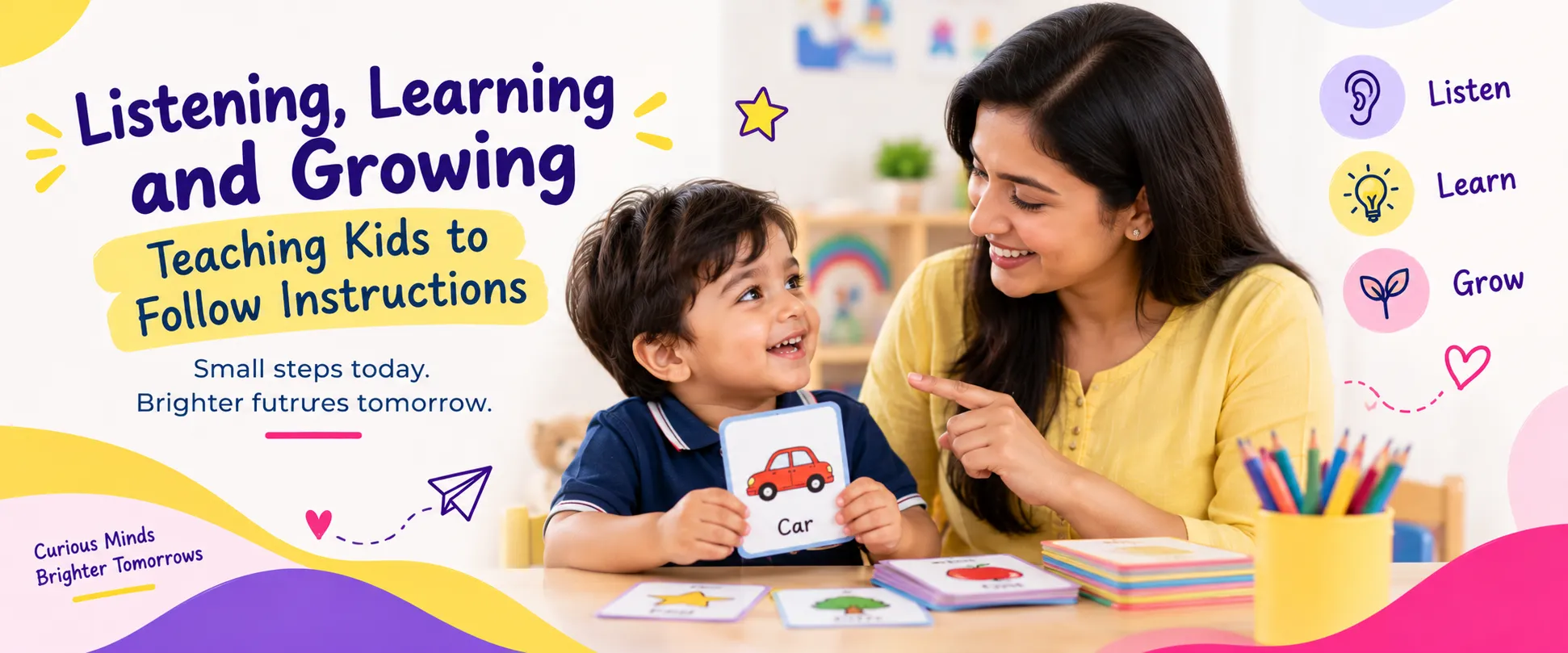
Learn how to teach kids to follow instructions with simple, positive strategies that build listening, attention, memory, independence and self-control.




Learning to follow instructions is an important part of early childhood development. Children develop this skill gradually as they strengthen listening, attention, memory, language and self-regulation. Parents can help by giving clear, age-appropriate directions, allowing processing time, using positive language and practising listening through everyday routines and play.
For more ideas on supporting early childhood development through age-appropriate learning experiences, explore Kidzee's preschool programmes.
If you're wondering how to teach kids to follow instructions, start with one simple direction at a time, make sure your child is listening, and gradually build towards two- and three-step instructions as their skills develop.
"Please put your toys away."
You ask once. Then twice. Maybe even three times before your child finally responds or perhaps, they become distracted halfway through the task.
If this sounds familiar, you're not alone. Learning to follow instructions is a skill that develops gradually during early childhood. It requires children to listen carefully, understand what is being asked, remember the steps, and act on them.
The good news is that this skill can be nurtured through everyday routines, play, and positive guidance.
Why Following Instructions Matters for Children?
Following instructions is much more than simply obeying adults. It is an important life skill that helps children become confident, independent learners.
Children who can follow simple directions are better able to:
- Participate in classroom activities
- Complete everyday tasks independently
- Stay safe in different environments
- Build strong listening and communication skills
- Develop self-control and responsibility
- Work cooperatively with others
Skills such as listening, communication, independence and self-regulation are an important part of a child's broader early learning journey. Explore Kidzee's preschool programmes to learn more about play-based early childhood education.
These abilities create a strong foundation for success at school and in daily life.
Why Young Children Struggle to Follow Instructions
It's important to remember that preschoolers are still developing their attention span, memory, and self-regulation.
A child may not follow instructions because they are:
- Deeply engaged in play
- Distracted by their surroundings
- Unsure what is expected
- Trying to remember several steps at once
- Still learning to manage their emotions
Rather than assuming they are being deliberately difficult, consider whether they need clearer guidance or a little more support.
What Skills Do Children Need to Follow Instructions?
Following instructions requires more than simply hearing what an adult says. Children need to pay attention, understand the language they hear, remember the instruction and organise their actions to complete the task.
For example, when a parent says, “Please put your crayons in the box and bring me your book,” a child needs to:
- Listen to the instruction
- Understand the words and meaning
- Remember the two steps
- Stay focused on the task
- Complete the actions in sequence
These abilities are closely connected with listening skills, language development, working memory, attention and self-regulation. Because these skills are still developing in young children, following instructions becomes easier with practice, repetition and supportive guidance.
How Do You Teach a Child to Follow Instructions?
To teach a child to follow instructions, give their full attention first, use short and clear directions, provide one step at a time, use positive language, allow time to process the instruction, and praise their effort. Listening games, stories, songs and everyday routines can also help children practise following directions in a fun, low-pressure way.
-
Get Their Attention First
Before giving an instruction, make sure your child is listening.
Move closer, gently say their name, make eye contact, and speak in a calm voice. Children are much more likely to respond when they know you are talking directly to them.
-
Keep Instructions Simple
Young children respond best to short, clear directions.
Instead of saying:
"Can you please go upstairs, find your shoes, put on your socks, and bring your water bottle?"
Try:
- "Please put on your socks."
- Then, "Now bring your shoes."
Breaking tasks into smaller steps makes them easier to remember and complete.
How to Teach Children to Follow Multi-Step Instructions
Once your child is comfortable following simple one-step directions, gradually introduce two-step instructions. Keep the steps familiar and connected.
For example:
One step: “Put your shoes by the door.”
Two steps: “Put your shoes by the door and bring your bag.”
Three steps: “Put your shoes by the door, bring your bag and sit at the table.”
If your child struggles, return to fewer steps and build up gradually. The goal is to develop confidence and understanding rather than test how many instructions a child can remember.
-
Give Positive Instructions
Tell children what you want them to do instead of focusing on what not to do.
For example:
- "Please use walking feet indoors" instead of "Don't run."
- "Use a quiet voice" instead of "Stop shouting."
Positive language is easier for young children to understand and follow.
-
Allow Time to Respond
Children need a few moments to process what they have heard.
After giving an instruction, pause before repeating it. This gives your child time to think and act independently.
-
Make Listening Fun
Listening skills grow through playful experiences.
Try games like:
- Simon Says
- Follow the Leader
- Musical Statues
- Action songs
- Treasure hunts with simple clues
These activities encourage children to listen carefully while having fun.
-
Praise Effort
Notice and acknowledge when your child follows instructions.
Simple comments like:
- "You listened so carefully."
- "Thank you for putting your toys away."
- "You remembered all the steps!"
Positive reinforcement encourages children to repeat good listening behaviours.
What Skills Help Children Follow Instructions?
Following instructions involves several developing skills, including listening, attention, language comprehension, working memory, self-regulation and the ability to complete a sequence of actions. These skills develop gradually during early childhood, so expectations should be matched to the child's age and individual development.
How to Build Listening Skills in Children Through Everyday Activities
Listening doesn't only happen during structured learning.
You can strengthen attention and listening skills while:
- Reading stories together
- Cooking simple recipes
- Playing board games
- Completing puzzles
- Singing rhymes and action songs
- Going for nature walks and talking about what you see
Each of these activities encourages children to listen, observe, and respond.
Everyday activities can complement the play-based learning experiences children encounter in preschool. Learn more about Kidzee's approach to early childhood learning.
How Parents Can Model Good Listening Skills
Children learn by watching the adults around them.
When you listen patiently, follow routines, and communicate respectfully, your child learns the value of listening and responding thoughtfully.
Showing the behaviour, you expect is often more powerful than simply talking about it.
How Many Instructions Can a Young Child Follow?
There is no single number of instructions that every child should be able to follow at a particular age. Younger children generally benefit from simple, one-step directions, while older preschoolers may gradually manage connected two- or three-step instructions as their attention, language comprehension and working memory develop.
If a child regularly struggles with instructions, simplify the task, reduce distractions and check that they have understood what you asked rather than assuming they are not listening.
Use Age-Appropriate Instructions for Young Children
Remember that young children are still learning. They won't follow every instruction perfectly every time, and that's okay.
Be patient, offer gentle reminders, and celebrate progress rather than expecting perfection. As their attention span and confidence grow, so will their ability to follow directions.
Small Steps, Big Life Skills
Teaching children to follow instructions isn't about demanding perfect obedience. It's about helping them develop the listening, attention, memory, and self-management skills they need to thrive.
With clear communication, playful learning, and consistent encouragement, everyday moments become opportunities to build these essential life skills.
Because every time a child listens, understands, and successfully completes a task, they are building confidence one simple instruction at a time
Key Takeaways
Teaching children to follow instructions is a gradual process that develops through everyday interaction, routines and play.
-
Get your child's attention before giving an instruction.
-
Use short, clear and age-appropriate directions.
-
Start with one-step instructions before introducing multiple steps.
-
Use positive language to tell children what to do.
-
Give children time to process what they hear.
-
Use listening games and everyday activities to practise.
-
Praise effort and progress rather than expecting perfection.
-
Adjust expectations according to each child's developmental stage.